The Danish Fiddle
This is an experiment more than an offering — a small dance-fiddle after a sixteenth-century Danish pattern, of the kind Richard went looking for in the old collections at the Grassi museum in Leipzig.
Where a violin is built up from many bent and glued pieces, this one is carved from a single block with a flat front board laid over it — the same way a crwth is made. Four strings, a short neck, and a bow: it sits on the road between the crwth and the violin, the Welsh way of working given a Danish and Flemish shape.
One has been carved so far. If the idea speaks to you, it is a conversation to be had rather than a thing off a shelf.
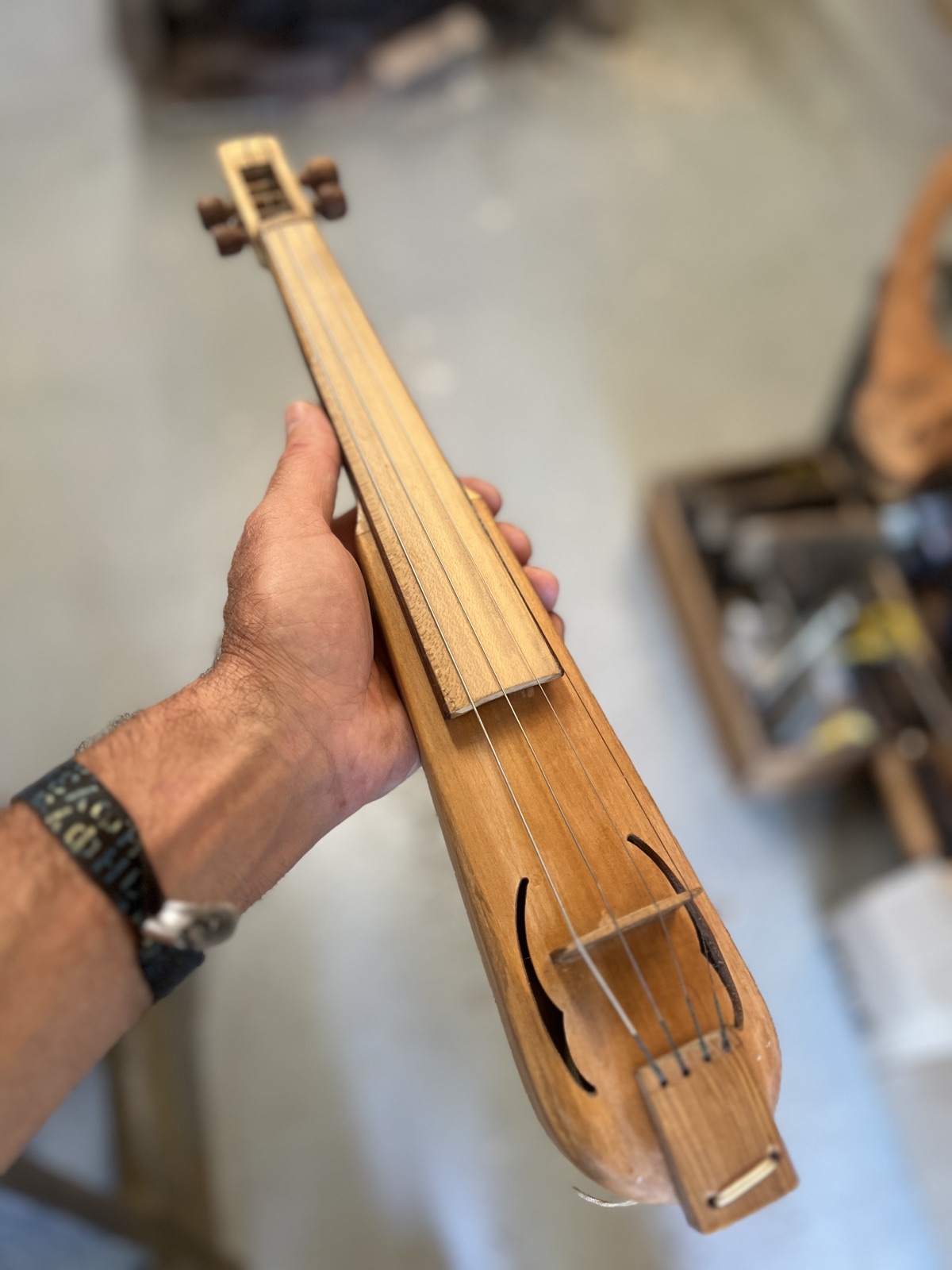
Between the crwth and the violin.
Before the violin settled into the shape we all know, there were a hundred carved fiddles being tried across Europe — each maker feeling his own way toward a voice. This little dance-fiddle is one of those roads not taken, drawn from a Danish and Flemish pattern of the sixteenth century.
It is made the Welsh way, not the Italian: the body carved from a single block rather than bent and glued, with a separate front board and four strings tuned open. The tail is levered against an end peg rather than fixed, so the pitch shifts a little as it is played.
It is a bench experiment, and offered as one — a rare thing, made for the curious.